Blog
NSW Commercial Battery Rebate 2026: What Businesses Need to Know
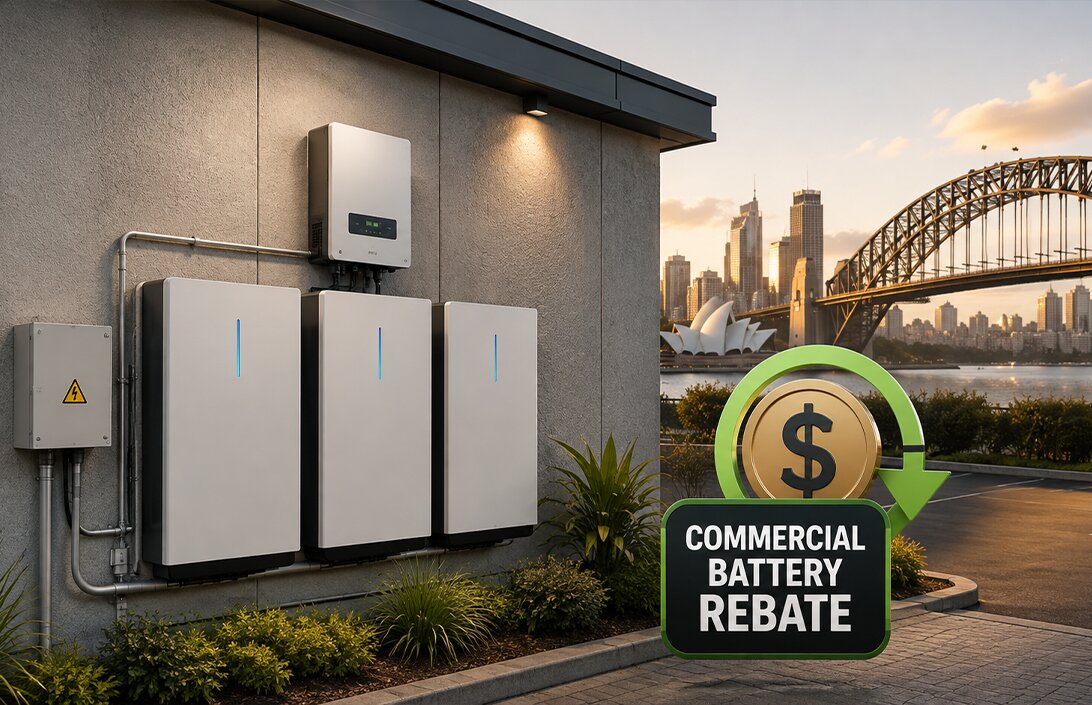
The Solar Battery Rebate NSW for eligible businesses starts on 1 September 2026, offering an upfront discount on qualifying battery installations. The incentive covers eligible business battery systems from 20 kWh to 30 MWh. The discount can be higher when new or additional solar capacity is installed with the battery.
If you operate a business in Sydney or elsewhere in NSW, this new incentive could reduce the upfront cost of commercial battery storage. It can also help businesses use more solar energy and manage electricity demand.
The NSW Government currently describes the program as a battery installation discount. It operates through the Peak Demand Reduction Scheme (PDRS). However, many businesses and search users refer to it as the NSW Battery Rebate.
Let’s understand the eligibility rules, battery sizes, potential discounts and application process.
What Is the Solar Battery Rebate NSW for Businesses?
The Solar Battery Rebate NSW is a new NSW Government incentive for eligible businesses installing qualifying battery storage systems.
The incentive becomes available from 1 September 2026. Eligible businesses can receive an upfront discount through participating installers.
The official guidance indicates discounts of around 20% to 30% for battery-only installations. The discount can increase to around 30% to 40% when a new or additional solar system is installed with the battery. These figures are indicative rather than guaranteed.
The final discount depends on several factors. These include the battery model, battery size, installation location and system design.
Installation complexity can also affect the final price.
Therefore, businesses should compare quotes before committing to an installation.
When Does the NSW Commercial Battery Rebate Start?
The NSW Commercial Battery Rebate starts on 1 September 2026.
The NSW Government announced the new incentive on 18 August 2026. The program is designed to help eligible businesses reduce electricity costs through battery storage.
There is currently no planned closing date for the business battery discount. The incentive operates under the PDRS, which is legislated through 2050 and reviewed periodically.
This means businesses do not need to rush into an unsuitable battery system.
However, businesses planning an installation should start comparing options early. Installer availability and project requirements can affect installation timelines.
How Much Is the NSW Battery Rebate for Businesses?
The NSW Battery Rebate Business incentive does not provide one fixed dollar amount for every business.
Instead, eligible installations receive a discount that depends on the project.
For battery-only installations, the current indicative discount is around 20% to 30%.
When a new or additional solar system is installed with the battery, the indicative discount increases to around 30% to 40%.
The actual amount can vary significantly between projects.
The battery model, system size, site location and installation requirements can all affect the final cost. Installer margins and compliance costs can also influence the quoted price.
The NSW Government has provided examples showing how significant the potential savings can be.
For example, a small business could receive a discount of around $37,000. A medium-sized business example could receive around $355,000. These are examples, not guaranteed rebate amounts.
Battery Only vs Battery and Solar
Businesses can receive the incentive when installing a battery without new solar.
However, the discount is smaller for battery-only installations.
A higher discount may apply when new or additional solar capacity is installed with the battery. This can make a combined solar and battery project particularly attractive for businesses planning a larger energy upgrade.
Who Is Eligible for the NSW Battery Rebate Business Incentive?
Businesses in NSW may qualify if they meet the program requirements.
The battery must have a total capacity between 20 kWh and 30 MWh.
The site must not be a residential building or data centre. The business must also work with an installer offering the incentive.
Required planning approvals must also be obtained.
For systems between 20 kWh and 200 kWh, the battery must appear on the Clean Energy Council’s approved battery list. Installation must also be completed by an installer accredited by Solar Accreditation Australia.
Larger systems have different requirements.
Businesses should therefore confirm eligibility before purchasing equipment or beginning installation.
Eligible Battery Sizes
The NSW Battery Rebate Business incentive covers batteries from 20 kWh to 30 MWh.
Systems below 20 kWh do not qualify under this business incentive.
Systems above 30 MWh also fall outside the eligible range.
This broad range means the incentive can apply to different commercial applications.
A restaurant may need a smaller system. A manufacturing facility may require a much larger battery.
The correct battery size depends on electricity consumption, solar generation and the site’s operating profile.
Businesses and Sites That Are Not Eligible
Not every site qualifies for the incentive.
Residential buildings are excluded from this particular business program. Data centres are also excluded.
Off-grid businesses cannot access this discount because the incentive is designed to reduce demand on the NSW electricity grid.
Businesses should also check whether they have already used this particular discount.
The program generally allows the discount to be accessed only once for a business installation.
How Does the NSW Commercial Battery Rebate Work?
The NSW Commercial Battery Rebate works through the Peak Demand Reduction Scheme.
The scheme supports technologies that can help reduce electricity demand during periods of peak grid pressure.
Battery storage can help businesses store electricity and use it when demand or electricity prices are higher.
The financial benefit is normally reflected as an upfront discount in the installation quote. Businesses do not generally receive a separate cash payment after completing the installation.
Understanding the Peak Demand Reduction Scheme
The PDRS uses energy certificates to support eligible energy-saving upgrades.
Under the commercial battery incentive, participating installers and Accredited Certificate Providers manage the certificate process.
This structure helps fund discounts for eligible battery installations.
For a business owner, the practical point is simple. The discount should be clearly shown in the installation quote.
You should understand the gross system price, discount and final amount before signing the agreement.
How the Upfront Discount Is Applied
The discount is normally included in the quote supplied by the participating installer.
The NSW Government recommends comparing quotes from multiple installers.
Each installer may offer different battery models and discount amounts. Therefore, comparing the final installed price is more useful than comparing the advertised discount alone.
Businesses should also check installation requirements, warranties, system capacity and after-sales support.
A larger discount does not automatically mean a better commercial battery solution.
What Battery Sizes Are Eligible Under the NSW Incentive?
The eligible range starts at 20 kWh and extends to 30 MWh.
This gives businesses considerable flexibility when designing a commercial energy storage system.
20 kWh to 200 kWh Batteries
Batteries between 20 kWh and 200 kWh are suitable for many smaller and medium-sized commercial applications.
Examples can include restaurants, takeaway businesses and convenience stores.
The NSW Government has specifically highlighted 20 kWh to 50 kWh systems for some small business applications.
For these battery sizes, approved battery equipment and qualified installation are important eligibility requirements.
A minimum payment also applies to batteries between 20 kWh and 200 kWh.
200 kWh to 30 MWh Batteries
Larger commercial and industrial sites may require batteries above 200 kWh.
The incentive extends to systems up to 30 MWh.
These larger systems have different compliance requirements.
For systems between 200 kWh and 30 MWh, the battery must meet applicable fire safety requirements. Installation must also be completed by a licensed installer.
Larger systems do not require the same minimum payment that applies to batteries between 20 kWh and 200 kWh.
Can You Get a Higher Discount by Installing Solar and a Battery Together?
Yes. Eligible businesses can receive a higher indicative discount when they install new or additional solar capacity with a battery.
The current guidance indicates around 30% to 40% for eligible battery installations combined with new or additional solar.
Battery-only installations have an indicative discount of around 20% to 30%.
The reason is straightforward.
Solar panels can generate electricity during the day. A battery can store excess generation for later use.
This combination can help businesses reduce their reliance on grid electricity.
The PDRS battery incentive does not directly provide the same battery discount for the solar component. However, businesses may qualify for separate Australian Government solar incentives.
Can a Business With Existing Solar Get the Higher Battery Discount?
Yes, an existing solar system does not automatically prevent a business from receiving the higher discount.
However, the business must install additional solar capacity.
The new solar must be installed within 90 days before or after the battery installation.
The additional solar capacity must equal at least 25% of the new battery’s capacity.
For example, consider a business installing a 100 kWh battery.
The business would need at least 25 kWh of additional solar capacity to meet this particular requirement.
The installer should confirm the exact project configuration before installation.
Can You Claim the NSW Battery Rebate If You Already Have a Battery?
Possibly, yes.
A business that already has a battery may still qualify when installing another battery.
However, the business must not have already claimed this particular discount for a previous battery installation.
Importantly, a battery installed before 1 September 2026 cannot receive this new discount retrospectively.
The NSW Government states that batteries commissioned before the start date are not eligible.
Therefore, businesses should discuss project timing with an eligible installer.
Can the NSW Battery Rebate Be Combined With Other Solar Incentives?
Yes, eligible businesses may combine the NSW battery discount with eligible Australian Government solar incentives.
The NSW Government specifically states that the battery discount can be combined with applicable Australian Government solar discounts.
This can be useful for businesses planning a complete solar and battery upgrade.
However, each incentive has its own eligibility requirements.
Therefore, businesses should not assume that every solar project automatically qualifies for every available incentive.
Ask your installer to explain each discount separately.
How to Apply for the NSW Commercial Battery Rebate
The process starts with choosing an installer that offers the NSW battery discount.
Step 1: Compare Accredited Installers
Start by comparing several installers.
Ask each installer whether they participate in the NSW battery incentive.
The quote should clearly show the discount and final installation cost.
Also compare battery brands, warranties, installation experience and after-sales support.
Step 2: Choose the Right Commercial Battery
The cheapest battery is not always the best choice.
Your battery should match your business’s energy consumption.
Your installer should consider your solar generation, peak demand and operating hours.
The NSW Government also warns that not every eligible battery is offered by every participating installer.
Step 3: Complete the Required Paperwork
The installer will provide the required nomination documentation.
This paperwork must be completed before installation begins.
The installer should also provide a quote showing the work, discount and final price.
Additional documentation may be needed for planning and network approvals.
Step 4: Install the Battery
Once approvals and paperwork are complete, installation can proceed.
A licensed electrician should complete the relevant installation work.
After installation, required declarations and installation evidence must also be completed.
What Could a NSW Business Save With the Battery Rebate?
The potential savings depend on the battery and project configuration.
The NSW Government currently gives indicative discount ranges rather than one fixed rebate.
For a battery-only project, the indicative discount is around 20% to 30%.
For a battery combined with new or additional solar, it can be around 30% to 40%.
Example: Small Business Battery
Imagine a small business needs a commercial battery for its daytime operations.
A 20 kWh to 50 kWh battery could be suitable for some smaller sites.
The NSW Government has highlighted a grocery store example with a potential discount of around $37,000.
This is only an example.
The actual discount depends on the system, installer and project requirements.
Example: Medium-Sized Business Battery
Larger businesses may require substantially more storage.
The NSW Government has provided an example of a medium-sized business receiving around $355,000 in discount.
Again, this is an illustrative government example rather than a guaranteed amount
A detailed site assessment is needed before calculating potential savings.
Why Should NSW Businesses Consider Commercial Battery Storage?
The NSW Battery Rebate Business incentive can make commercial battery storage more accessible.
However, the incentive is only one part of the business case.
Reduce Electricity Costs
A battery can store energy for later use.
Businesses can use stored energy during periods when grid electricity is more expensive.
This can help reduce overall electricity costs.
Actual savings depend on the business’s electricity plan and consumption pattern.
Store More Solar Energy
Businesses with rooftop solar often generate significant electricity during daylight hours.
Some of that energy may not be used immediately.
Battery storage allows excess energy to be stored.
The business can then use that energy later.
Reduce Peak Demand
Peak demand can contribute significantly to commercial electricity costs.
Battery storage can help reduce the amount of electricity a business draws from the grid during high-demand periods.
This can improve energy management.
Improve Energy Resilience
Some battery systems can provide backup power during outages.
However, backup functionality depends on the battery system, inverter and installation design.
Businesses should ask whether backup power is included before choosing a system.
What Should Businesses Check Before Choosing a Battery Installer?
Choosing the right installer is important.
First, confirm that the installer offers the NSW battery discount.
Next, check the battery’s eligibility and installation requirements.
For systems from 20 kWh to 200 kWh, the equipment must meet the relevant approved battery requirements. Installation also requires an appropriately accredited installer.
For larger systems, fire safety and licensed installation requirements apply.
Businesses should also compare:
- System capacity: Does the battery match your energy demand?
- Solar compatibility: Can the battery work effectively with your existing or new solar system?
- Warranty: What equipment and workmanship warranties are included?
- Backup: Does the system provide backup power?
- Monitoring: Can you monitor energy generation and battery performance?
- Final price: Is the NSW discount clearly included in the quote?
These questions can help businesses avoid choosing a system based only on the advertised rebate.
Is the NSW Commercial Battery Rebate Worth Considering in 2026?
For many eligible businesses, the new incentive makes commercial battery storage worth investigating.
The strongest opportunity may come from businesses with high electricity usage, existing solar or plans to install solar.
Battery storage can help these businesses use more renewable energy and manage electricity demand.
The incentive can also reduce the upfront cost of an eligible battery system.
However, businesses should look beyond the rebate percentage.
The right battery depends on electricity usage, solar generation, operating hours, tariffs and the required backup capacity.
Therefore, a professional assessment is important before making a decision.
Conclusion
The Solar Battery Rebate NSW for eligible businesses starts on 1 September 2026, with indicative discounts of around 20% to 40% depending on the battery project and whether new or additional solar is installed. Eligible business batteries range from 20 kWh to 30 MWh.
For NSW businesses, this new incentive creates an opportunity to reduce the upfront cost of commercial battery storage.
Battery Deals can help businesses assess their solar and battery requirements, compare suitable solutions and plan professional installation.
If your business is considering a commercial solar battery in Sydney or elsewhere in NSW, now is a good time to review your energy usage and request a tailored quote.
Get in touch with Battery Deals to explore your commercial battery options and understand whether your business may qualify for the NSW battery incentive.
FAQs
When does the NSW Battery Rebate start?
The NSW business battery discount starts on 1 September 2026.
How much is the NSW Battery Rebate?
The current indicative discount is around 20% to 30% for battery-only installations. It can increase to around 30% to 40% when new or additional solar is installed with the battery.
What battery size qualifies?
Eligible business batteries must have a total capacity between 20 kWh and 30 MWh.
Can I get the rebate without solar panels?
Yes. A business can receive a smaller discount when installing an eligible battery without new solar.
Can I add solar to get a higher discount?
Yes. Additional solar must meet specific requirements. It must be installed within 90 days before or after the battery. The new solar capacity must equal at least 25% of the battery’s capacity.
Can an existing solar system qualify?
Yes. Businesses with existing solar can potentially receive the higher discount by installing qualifying additional solar capacity.
Can an existing battery qualify?
A business may be eligible for a new battery installation if it has not already claimed this particular discount. However, batteries commissioned before 1 September 2026 cannot receive the new discount retrospectively.
Is there an end date for the NSW Battery Rebate?
There is currently no planned closing date. The incentive operates under the PDRS, which is legislated to 2050 and subject to regular review.
Can an off-grid business claim the incentive?
No. The business must be connected to the electricity grid to access this particular discount.
Planning a Commercial Battery Installation in NSW?
Find the right battery solution for your business and understand your available incentives. Get a Free Commercial Battery Quote.
Latest from Our Blog